
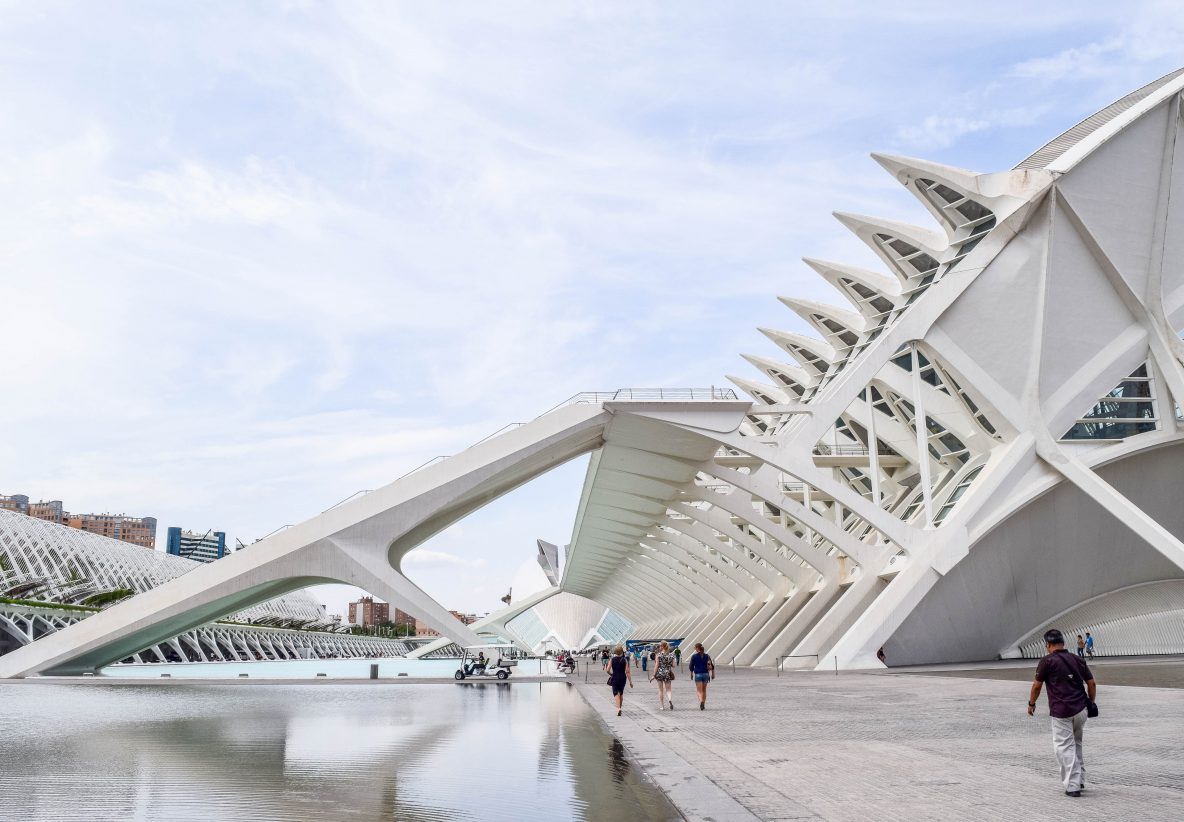
On the west side of Valencia, Spain, built on a former river bed, is the City of Arts and Sciences. It’s a collection of futuristic buildings designed by the Spanish architect Santiago Calatrava (along with a few from Mexican architect Felix Candela.) It’s not just architecture eye candy, though. They house a lot of fun, cultural activities, from an aquarium to a science museum and a theater.

The Architecture
As an architect/designer, I have a love/hate relationship with Santiago Calatrava’s work. (And I will admit that architects are design snobs.) Before I went to architecture school, I would have said he was my favorite architect. That was from a strictly visual standpoint, though. Even though that’s definitely not the case now, his buildings are certainly fantastic and awe-inspiring. Architecture is sometimes thought of as a mix of art and engineering, and I think Calatrava takes that to an extreme. (Which works for him). The engineering that goes into actually constructing his artistic visions is pretty impressive.


I visited Valencia and the City of Arts and Sciences at the beginning of my final year in architecture school. By this time I had stopped thinking that showstopping architecture = good architecture. My design tastes had changed to where I appreciated a good block of concrete more than anything flashy. (Yes, huge Brutalism fan here). So therefore Calatrava wasn’t very high on my list of favorite architects anymore.
But even with my architectural snobbiness, I have to admit I was still looking wide-eyed at these buildings. The futuristic designs resemble skeletons or spines, and it seems almost extraterrestrial. The sheer scale of them is just massive. You really do feel like a tiny human wandering through an alien landscape. It can be disconcerting sometimes, but mostly intriguing.


Other than gawking at the architecture, there’s a lot to do here, especially if you’re interested in science. My group and I chose to buy a 2-day pass for entry into 3 of the buildings – the aquarium, the science museum, and the theater for an IMAX film. The 2-day pass worked out perfectly for us because we arrived in the evening with not enough time to see everything we wanted. We visited the science museum that evening, then back the next afternoon to explore the aquarium and see the film.

Oceonografíc


The aquarium, or Oceonografic, was my favorite out of all of them. I wanted to be a marine biologist as a kid (how did that turn into architecture??). And because I’m still very obsessed with the ocean and sea animals, I loved this place. It’s the largest aquarium in Europe, and has a wide variety of animals from beluga whales and dolphins to penguins and sea lions. It’s separated into seven different marine environments that are mainly underground. You access these through above-ground buildings, which makes the whole place even more fun.
These particular buildings were designed by the Mexican architect Felix Candela. He’s known for using hypercurved concrete shell structures in Mexico, and that’s similarly used here too. They are absolutely amazing. I was in full-on geek mode wandering through this aquarium, from seeing penguins (my favorite animals) to also seeing beautiful concrete architecture.
Prince Felipe Museum of Sciences


The Prince Felipe Museum of Sciences is a lot of fun as well. It’s a hands-on museum with interactive exhibits, and every branch of science is on display. The one rule of the museum is that you can’t not touch things. It’s a massive building with so much to see and do inside. I spent about two hours wandering through here, and I still feel like I didn’t see enough. This particular building out of all of them is one that reinforces the feeling of something alien. With its skeletal shape and vast spaces in the interior, you feel very small. Walking in the atrium is like walking through the rib cage of a giant whale, or something less weird than that.
L’Hemisferíc

L’Hemisferic is an audio-visual space where they have an IMAX theater. Out of the Calatrava designed buildings, this one was my favorite. It resembles a human eye to symbolize observation of the world. Pretty cool, huh? On nice days you can rent a little rowboat and paddle around the water surrounding the “eye of the city”.


The Palau de les Arts sits behind L’Hemisferic. It’s an opera venue with theater, dance and opera performances for more cultural experiences. I didn’t get to see this building up close while I was there, unfortunately, so I can’t say much more about it.
The Umbracle is an open-air space across the large water feature from the Prince Felipe Museum. It’s has great views of the other buildings, and it’s pretty nice to walk through as well.

If you’re in Valencia, the City of Arts and Sciences is a must see even for non-architects (but also go see the rest of the city because Valencia is an incredible place).
Pin it


